French Artist Lived in Neworleans From Provence Abstract Collage Art
Louis Antoine Collas (Bordeaux, 1775 - Bordeaux, 1856) was a portrait and miniature painter from French republic.[1] [2] Collas'due south work primarily consisted of oil paintings and miniature h2o colors.[3]

Portrait de Jean-Charles-Auguste, dit John, Géraud

Portrait d'Elisabeth Ferriere, épouse de John Géraud
Collas moved to America in the 1810s.[iv] [5] Collas was one of the most influential and of import French miniature painters that came to America and New Orleans. He exhibited in the Paris Salon as well equally several Academies of Fine Arts in America. Although originally from France, Collas is considered an American artist.
Creative person's Life [edit]
Louis Antoine Collas was born in Bordeaux, France in 1775. Trivial to no information can be found on the early on childhood of Collas. Collas started his fine art career and studied under François-André Vincent in Paris. He debuted at the Paris Salon in 1798 with i self portrait. The next yr he sent several miniatures to the Paris Salon and would periodically continue to do so. Betwixt 1803 (though information technology is claimed he moved in 1808) and 1811, Collas moved to Leningrad, Russia where he painted aristocrats and diverse people of high status. While in Russia, Collas worked for Arbiter Alexander I's court. Other notable figures that he painted while in Russia were Duchess Catherine Pavlovna and Prince Serge Nikolaewitch Galitinne.
Collas left Russian federation in 1811 and moved back to Paris. After returning to Paris, Collas exhibited at the Paris Salon of 1812. Between 1812 and 1816, lilliputian is known of what he was doing until he arrived in New York City and listed himself equally "Lewis Collers" in New York City directory. He exhibited xiii miniatures, iii of which were on porcelain, at the Academy of Fine Arts in New York between 1816 and 1820. He exhibited several miniatures at the Pennsylvania Academy of Fine Arts in 1819. Collas traveled along the Due east Coast advertizement in Philadelphia, Baltimore, and Charleston. Collas returned to New York in 1820 where he exhibited in some other Academy of Fine arts exhibition. He visited New Orleans in 1822 and was one of the earliest European artists to work in New Orleans. He was identified equally a "portrait and miniature painter" and that he was living at 35 St. Peter Street. He had come up into the painting genre for local patrons before Jean-Francios de Vallee, a miniature painter who was superior to Collas. Vallee was successful but he didn't receive every bit much attention in the printing every bit Collas did. Collas was praised in the Louisiana Gazette. On January xx, 1823 the Louisiana Gazette stated:
"Nosotros notice with pleasure at Mr. Elkin's Exchange a Frame enclosing miniature paintings by Mr. Collas. The finish of his portraits leave nothing to exist desired for resemblance. We tin compare it with the life-sized portrait above the frame. Information technology is a speaking likeness. Everyone can recognize the artist whom one of his colleagues has delineated. Unfortunately, fate has snatched Lancelin from united states. I do not pretend to make any comparison betwixt the 2 painters, but I volition limit myself by saying that the real and beautiful talent of Mr. Collas should exist encouraged in all cities, and since those I have seen in French republic, I take plant aught more than graceful than his works."
Collas announced his render in the New Orleans papers with notices nigh every yr after his flattering criticism. These notices stated ads such equally "Collas, L.- Painter, Has the honor of informing his friends and the public of New Orleans, that he has returned to this city, and intends to practice his fine art in portrait and miniatures." These adds continued from 1823 to 1829 commonly around Apr and were about identical. One-time between 1831 and 1832, Collas returned to Paris. He exhibited again at the Paris Salon, but didn't receive every bit much attention or observe as what he usually achieved. It is believed that Collas died in Paris in 1833, only no documentation tin exist constitute.[half dozen] Collas's place of death is unknown.
Artist's Work [edit]
Collas's portrait of Mrs. Andry was probable a member of the Andrey family (also spelled Andry or André). The Andrey family was very agile in federal and colonial militias in Louisiana. The family endemic multiple plantations in St. James Parish. Collas'due south Mrs. Andry is very likely to exist the aforementioned Mrs. André who intrigued John James Audubon. Audubon wrote in his diary on Feb 21, 1821 saying "one of those discouraging incidents connected with the life of the artists. I had a likeness spoken of in very rude terms by the fair lady it was made for, and perhaps will loos my time and the reward expected for my labours." Audubon identified her after past her proper name: "Mrs. André - I mention name as I may speak more of the likeness every bit the occasion will crave." Collas depicts a possible widow André, who lived on Armour Street in 1829. Her optics are grey which seem sad and tired. Her afar gaze is to requite off the sense of contemplation, deep emotion and reverie.
Collas's Portrait of a Free Woman of Color Wearing a Tignon was painted in 1829 while he was in New Orleans. This painting resides in the New Orleans Museum of Art on display. The woman in the painting was an unknown free woman of color which was pretty rare especially in southern states similar Louisiana. The woman in the picture show is wearing a tignon, a headdress worn by women in Louisiana with African descent. A constabulary in 1786 mandated both women of costless colour and enslaved dark-skinned women must wear a head scarf and then that could be distinguished from white women. Gratis women of colour subverted the intent of the police force and adopted vibrant luxury fabrics to habiliment for their own artistic cocky-fashioning. The woman in the painting seems to be proud of her heritage, and is proud to wear her vibrant green tignon. She is seated, commonly seen in portraits of women, with a smile on her confront while staring straight at the viewer. Her expression gives a sense of sarcasm. Her expression reads, "You lot thought this would oppress us, but all y'all id was give u.s. a bully manner trend."
-

Portrait of Mrs. Andry
-
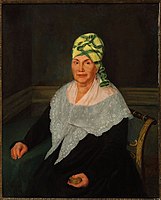
Portrait of a Free Adult female of Color Wearing a Tignon, 1829
References [edit]
- ^ "Louis Antoine Collas - Entries - KnowLA, Encyclopedia of Louisiana".
- ^ Cincinnati Fine art Museum; Julie Aronson; Marjorie E. Wieseman (2006). Perfect Likeness: European and American Portrait Miniatures from the Cincinnati Art Museum. Yale Academy Press. pp. 120–1. ISBN0-300-11580-half-dozen.
- ^ American Paintings & Historical Prints from the Middendorf Collection: A Catalogue of an Exhibition. Metropolitan Museum of Fine art. 1967. pp. 24–5. GGKEY:A37137F0LRC.
- ^ Pennington, Estill Curtis. Downriver: Currents of Fashion in Louisiana Painting, 1800-1950. Pelican Publishing. pp. 45–vi. ISBN978-1-4556-0370-1.
- ^ Federal Writers' Projection (31 October 2013). The WPA Guide to Louisiana: The Pelican State. Trinity University Press. p. 156. ISBN978-1-59534-216-4.
- ^ "Harris Antiques, LTD : A Royal St. French Quarter Antique Dealer".
Source: https://en.wikipedia.org/wiki/Louis_Antoine_Collas
0 Response to "French Artist Lived in Neworleans From Provence Abstract Collage Art"
Post a Comment